Flight Attendant Layover Time Zones: A Family Guide
What time is it on their layover? How families can read local time, base time, overnight flights and daylight saving on a flight attendant roster.
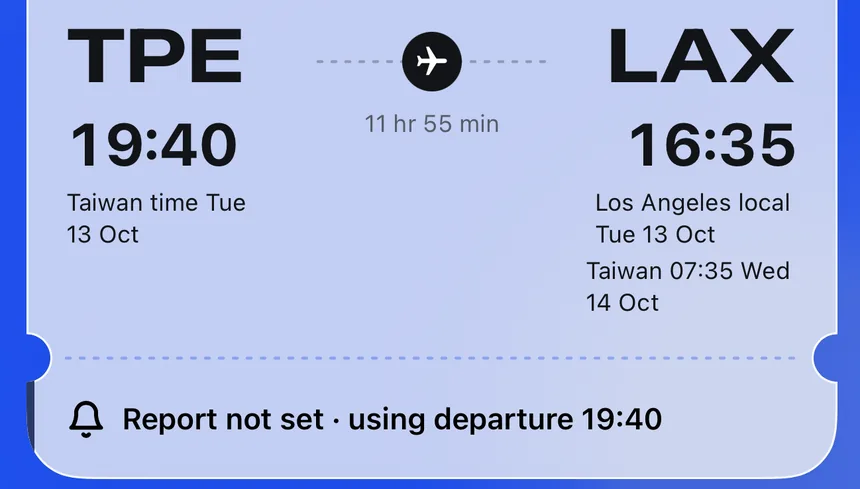
When someone in the family is cabin crew, two questions come up again and again: ‘What time is it there?’ and ‘When do they land?’ Get the time difference wrong and you might call just as they’ve fallen asleep, or turn up at arrivals two hours early. This guide uses real examples to explain layover time zones, flights that cross midnight and daylight saving, and shows how Feiban’s boarding pass puts both clocks side by side.
Local time or base time? Know which clock you’re reading
Before you read any flight time, ask one question: whose clock is this? Feiban follows the same rule as airline timetables. Departure times are in the local time of the departure airport, and arrival times are in the local time of the arrival airport.
- Base time: the clock where the cabin crew member is based, which is usually home. For crew based in Taiwan, that’s Taiwan time, and it’s what the examples in this guide use. A flight leaving base shows its departure in base time.
- Local time: the clock in the layover city. On a flight to Los Angeles, the arrival time is Los Angeles time.
- Time difference: how many hours apart the two clocks are. As the next section shows, that number isn’t fixed.
On the roster itself, every company writes layover days its own way. Common generic codes include LO and LAY, which mean an overnight layover away from base (there are more in our guide to roster codes). If Feiban doesn’t recognise a day, it flags it for you to choose rather than guessing.
The time difference depends on the date: daylight saving
Taiwan doesn’t use daylight saving time, but many layover cities do. They change their clocks once in spring and once in autumn, and each change moves the gap with Taiwan by an hour. Here’s how that works out in 2026:
- Los Angeles is 15 hours behind Taiwan until the end of October. From 1 November, when the clocks go back, it’s 16 hours behind.
- Paris goes from 6 hours behind Taiwan to 7 hours behind from 25 October.
- Sydney, in the southern hemisphere, moves the other way: daylight saving starts on 4 October, putting it 3 hours ahead of Taiwan, compared with 2 hours ahead in June.
- Tokyo doesn’t change its clocks and stays 1 hour ahead of Taiwan all year. India is 2 hours 30 minutes behind, a reminder that time differences aren’t always whole hours.
If the crew member’s base also uses daylight saving, as the UK does, the gap can shift when either clock changes.
That’s why Feiban always works out the time difference for that specific date, using each city’s time zone rules, daylight saving included. The flight day’s details show the layover city’s GMT offset and the difference on that date, such as GMT-7 and ‘15 hours behind Taiwan’. If the layover city is about to change its clocks within the next week, the Layover now card gives you a heads-up too, for example ‘From 1 Nov, the time difference becomes 16 hours’.
Crossing midnight: departure day and landing day can differ
Long-haul flights often run past midnight, and crossing the International Date Line makes it even more confusing. Take the boarding pass at the top of this page: it leaves Taipei (TPE) at 19:40 on Tuesday 13 October and flies for 11 hours 55 minutes, landing in Los Angeles at 16:35 local time, still on the 13th. It looks as if it lands before it took off. Back in Taiwan, it’s already 07:35 on Wednesday 14 October.
The flight home works the other way round. Say it leaves Los Angeles at 23:50 local time on Thursday 22 October and flies for 14 hours 50 minutes: it lands in Taiwan at 05:40 on Saturday 24 October, and it can feel as if a whole day has gone missing. Flying east across the Date Line, the local landing date can even be a day earlier than the departure date.
On Feiban, the date on each boarding pass is the local date where the flight departs. Under each time you’ll see that airport’s local date, and the base-time line at the layover end adds the date whenever it falls on a different day, as in ‘Taiwan 07:35 Wed 14 Oct’.
How Feiban’s boarding pass shows both clocks
Each flight gets its own boarding pass, with one set of times for departure and another for arrival:
- The large figure is the airport’s local time, labelled ‘Taiwan time’ or ‘Los Angeles local’, so you always know which clock you’re looking at.
- The layover end adds a line in base time, such as ‘Taiwan 11:20’, so there’s nothing to convert.
- A small tag shows where each time came from: ‘Scheduled’, ‘Estimated’ (read by AI from a roster screenshot and not yet confirmed) or ‘Corrected manually’.
- If a flight’s date can’t be worked out yet, the pass shows only the scheduled local times at each end and marks a date change as ‘+1 day’. It doesn’t convert to base time, because without a date there’s no way to account for daylight saving.
- If no times can be found, the pass says ‘Scheduled times TBC’. If the departure and arrival times don’t add up, it says ‘Departure and landing times don’t match up’. It never shows a guessed time.
Why the airline’s published times come first
The times in Feiban are scheduled times. Some frequently flown routes have built-in scheduled times; for other flights, times come from the roster or a flight number lookup. Actual departures and arrivals can be earlier or later because of weather, air traffic control or conditions at the airport, and the latest changes are published by the airline.
If the person who set up the roster spots a time that’s wrong, they can tap ‘Wrong time? Fix it’ on that day’s boarding pass and enter the time the airline has published. The pass is then marked ‘Corrected manually’.
Three habits for families
- Check the time at the layover before you call. Between 10pm and 7am there, Feiban suggests something like ‘It’s nearly midnight in Los Angeles, so maybe just send a message’.
- When you’re meeting a flight, read the base-time line, not the local time. If the flight crosses midnight, check the date as well.
- In the week the clocks change, keep an eye on the time difference, and before you set off for the airport, go by the airline’s published times.